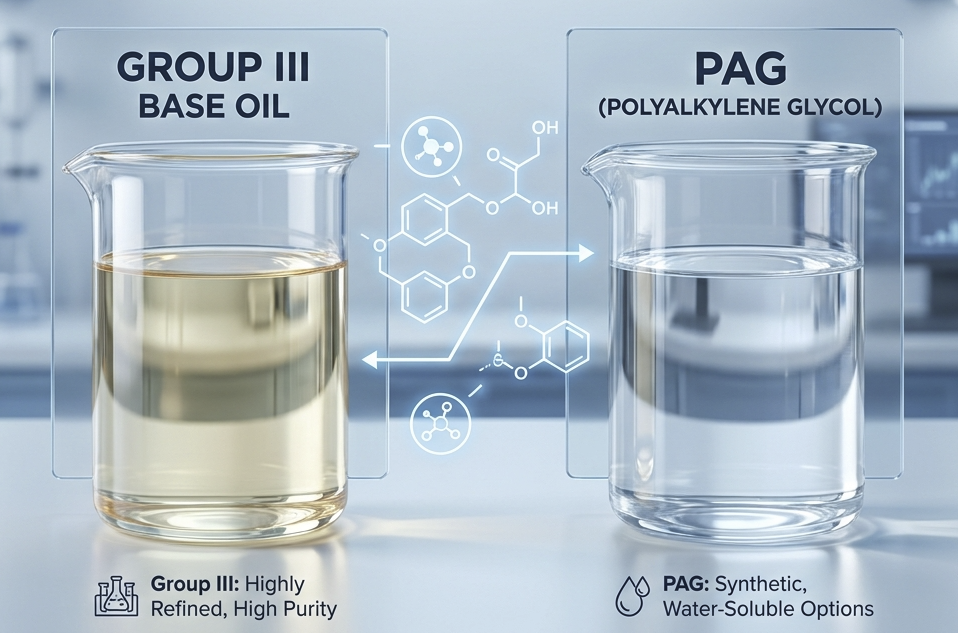
In our previous article for this series, we examined how the Group III base oil crisis is reshaping the lubricant market: Hormuz disruptions, export cuts, prices increases. Many formulators turned to PAG (polyalkylene glycol) as a technically superior alternative. [1]
But here's the catch: the raw materials used to make PAG, ethylene oxide (EO) and propylene oxide (PO), have been on their own price rollercoaster since the same Iran-Israel conflict began. The very crisis pushing formulators toward PAG is also driving up the cost of making it.
So if both Group III and PAG are getting more expensive, does PAG still make financial sense? Yes, but you need to look past the per kilogram price tag and think about supply chain strategy, not just chemistry.
The Feedstock Squeeze
Ethylene oxide is PAG's primary building block. When the conflict escalated on February 28, 2026, the EO market changed violently. [2]
In China, FOB prices climbed 65% in six weeks, with no parallel in the modern EO market. [2] Chinese domestic prices surged 52.73% in March alone. [3] Europe held the highest global benchmark at $1.64 per kg FOB Rotterdam, driven by naphtha-based ethylene costs tracking Brent crude above $111 per barrel. [2]
Propylene oxide (PO) hit multi-year highs in parallel, with propylene jumping from $600 to $900 per ton between February and late March. [4] ChemAnalyst confirmed PAG price indices rose across all regions in Q2 2026 — US producer prices up 5.5% year-over-year, Germany's supply tightened, China's input costs up 4.1%. [5]
The Iran-Israel conflict disrupted the Strait of Hormuz, through which approximately 15% of global polyethylene and polypropylene production flows. [6] Even after partial reopening, European chemical supply remained tight due to "reduced imports and Middle East ethylene shocks." [5]
↑ Back to contentsWhy PAG Still Wins
- PAG Isn't Facing a Supply Cutoff but Group III Is: Group III supply was physically disrupted. Middle Eastern exports cut by more than 70% between March and May 2026. [7] Producers pulled offers entirely. PAG, by contrast, is available. The PAG base oil market was valued at $6.81 billion in 2025 and is projected to reach $9.10 billion by 2033. [8] You might pay more, but you can actually buy it, and availability has a premium when your alternative is rationed.
- Longer Drain Intervals Slash Total Consumption: in compressor applications, mineral oils need changes every 2,000–4,000 hours. PAG extends that to 6,000–8,000 hours, with some formulations reaching 12,000. [9][10] Over an 8,000-hour cycle, a mineral oil compressor needs 2–4 changes. A PAG-formulated one needs one. You're buying fewer kilograms, reducing labour, and minimising downtime.
- Energy Savings Compound: a 2025 peer-reviewed study in the International Journal of Fluid Power found polyglycol-based lubricants in screw compressors delivered "decreased energy usage, diminished maintenance intervals, and prolonged compressor lifespan." [11] Machinery Lubrication documented synthetic upgrades reducing energy usage by approximately 3%, tens of thousands of dollars annually on industrial equipment. [12]
- The Group III Price Gap Hasn't Closed: jobbersWorld reported in late July 2026 that "Group III costs are still working through the lubricant supply chain" — transaction prices roughly $8 per gallon above pre-conflict levels. [7] European Group I and III grades are up approximately 175%. [13] Shell's new 300,000 tpa Group III plant in Germany won't come online until 2028. [14] This isn't reversing next quarter.
Why One Source Is Never Enough
The Group III crisis exposed a truth procurement teams have been quietly acknowledging: single-source dependency is the most expensive "cost saving" a business can make.
KPMG's 2026 survey found 38% of procurement leaders now name supplier diversification a core responsibility, with resilience closing the gap on cost as top priority, just a 7-point spread (47% vs. 40%). [15] The International Data Corporation (IDC) forecasts 50% of companies will shift to balanced multi-shoring strategies. [16] The shift is driven by hard experience: COVID-19 logistics costs surged 300–400% when single-source dependencies broke. [17] Russia-Ukraine removed Russian base oils overnight. Iran-Hormuz took out 70% of Group III exports. Each crisis reinforced the same lesson: if all your supply flows through one region, one chokepoint, or one chemistry, you don't have a supply chain, you have a bet.
Research in Springer's Managerial and Decision Economics found that "multi-sourcing can be viewed as an investment in increasing the resilience of supply chains by reducing dependency on political risks." [18]
↑ Back to contentsHow Meecarigno Built Diversification In
- Multiple chemistries, not just multiple suppliers. We consider PAG, PAO, and esters as complementary risk mitigants, not competing product lines. When Group III tightens, PAG is a pre-qualified alternative. When PAG feedstock costs rise, PAO and ester options remain.
- Free technical tools. Our PAG Grade Selector, TCO Calculator, and Oil Drain Interval Calculator let customers evaluate alternatives against their actual operating parameters before committing. [19] In a crisis, the ability to evaluate alternatives quickly is itself a competitive advantage.
- Geographic diversification. With 44% of Group III tied to the Middle East and 25% to Asia, [20] our supplier base is deliberately spread across multiple regions. When one corridor tightens, we have qualified alternatives already in place.
Case Study: Meridian Greases
Consider a mid-sized grease manufacturer producing 2,000 tonnes annually, 60% mineral-based, 40% synthetic-blend, using lithium-complex thickeners and Group III base oils for premium lines.
The squeeze: Group III up 175%. [13] Lithium hydroxide volatile (prices rose 715% between Q3 2021 and peak, EV battery demand competes for the same supply). [21] Additive costs up 45% cumulative (BASF raised 20% then added 25% on top). [22] Customers pushing back on price increases.
The strategic response:
Segment by application. Group I/II for standard greases at moderate temperatures. Qualify PAO and ester alternatives for premium lines now, before the next shock. PAO greases handle -50°C to 150°C vs mineral's -20°C to 120°C. [23]
Qualify polyurea thickeners. Polyurea greases offer 3–5x better life expectancy than lithium-based, and are already standard in fill-for-life sealed bearings. [24] Reduces lithium dependence and gives customers a longer-life product at a premium.
Reframe pricing around TCO. Synthetic grease costs 3–8x more upfront but lasts 3–5x longer. [25] For a customer running 500 bearings with quarterly relubrication, extending intervals to 6 months halves grease consumption, labour, and downtime. That's the argument that wins with finance.
Build strategic inventory. ILMA says conditions won't resolve until mid-2027. [26] Maintain 60–90 day buffers on irreplaceable feedstocks; accept tighter inventory on commodity inputs where alternatives exist.
Give customers evaluation tools. Tools that let engineers input operating parameters and get TCO comparisons across chemistries remove the friction from switching. This is exactly what Meecarigno's free online tools do. [19]
The outcome: No single feedstock exceeds 40% of input cost. Premium products with longer life cycles carry higher margins that absorb inflation. Customers stay because Meridian offers alternatives when competitors are still waiting for Group III to come back. As we noted in our previous article, the companies that survived the spring 2026 crisis were the ones who had already built optionality into their supply chain. [1]
↑ Back to contentsThe Bottom Line
The instinct when facing price increases is to defer switching decisions, wait for normalisation before committing. That instinct is wrong in this market.
Group III isn't normalising, it's structurally constrained until 2028 at the earliest. PAG's feedstock costs are rising moderately, not disappearing. And the total cost of ownership math works: fewer oil changes, reduced energy consumption, longer equipment life, and the avoided cost of supply disruptions.
The conversation with finance is not "PAG is cheaper than Group III." It is "PAG costs more per kilogram but costs less per operating hour and it's actually available when your alternative might not be."
Single-source strategies optimise for cost in calm markets. Multi-source strategies optimise for survival in volatile ones. The market has not been calm since 2020.
In a market where availability is the new affordability, optionality is not a luxury. It is a strategy.